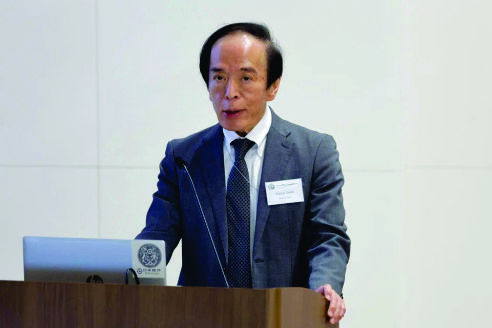
Bank of Japan (BOJ) governor Kazuo Ueda indicated a good chance of an interest-rate hike this month, if the risk of hotter-than-expected inflation looks bigger than the potential hit to the economy from the Middle East crisis.
On Wednesday, in his final scheduled speaking event in Tokyo ahead of a closely watched policy meeting, he said: “Even if the situation remains unclear, should it be judged that upside risks to prices outweigh downside risks to economic activity, it will be necessary to thoroughly discuss the pros and cons of raising the policy interest rate.”
So long as the Middle East turmoil calms and inflation gradually reaches its 2 per cent target, the central bank will raise rates at an appropriate pace, he added.
“Based on the data and anecdotal information available thus far, the upside risks to prices appear to be greater overall and are likely to emerge sooner,” he noted.
His remarks point to a high chance of a rate hike in June, though they were not as explicit as the comments he made telegraphing the previous two increases.
He still needs to monitor heightened uncertainty over the Middle East conflict, developments in prices as well as Prime Minister Sanae Takaichi’s stance on monetary policy.
Hideo Kumano, executive economist at Dai-Ichi Life Research Institute and a former BOJ official, said: “Ueda’s remarks are clearly indicating a rate hike. The BOJ will probably raise rates this month.”
The governor was speaking ahead of a board meeting taking place from June 15 to 16.
Traders are assigning a roughly 85 per cent chance as at Wednesday (Jun 3) afternoon of a quarter-point hike that will lift the benchmark to the highest since 1995.
The board held policy settings steady in April with a six-to-three vote, the biggest split under Ueda’s watch.
It is another indication of concern among members of the board over waiting too long to move on inflation.
Two members who backed a hold at that gathering have since spoken in favour of a near-term hike without specifying a preferred timing, citing upside price risks stemming from the war in Iran.
Jane Foley, senior FX strategist at Rabobank, said: “While not making a policy decision today, he makes (it) clear that a rate hike this month is firmly up for discussion and signs off by expressing confidence that Japan’s economy will be able withstand the current shock.
“This suggests to me that there is a strong chance that he will be endorsing a rate hike this month.”
Data has presented a mixed picture of the economy of late. Consumer inflation in Tokyo decelerated in May to the slowest in four years, and the latest capital spending figures were weaker than expected.
Ueda appeared to dismiss the weaker inflation data, as he said the BOJ expects prices to pick up due to oil prices. The bank has already sharply lifted its forecast for inflation to 2.8 per cent for the year ended March.
Officials have maintained that even with an increase in borrowing costs, financial conditions will remain accommodative.
The assertion means the central bank will still be working hand in hand with Takaichi’s government to support the economy.
It is threatened by rising costs, which may squeeze corporate margins while also weighing on domestic demand.
The weak yen – despite record intervention in the past month – may also be nudging the BOJ towards a rate hike in June.
High oil prices stemming from the Middle East conflict have not only weighed on the currency, but also upended the US Federal Reserve’s policy path.
Source: businesstimes