The infrastructure financier said on Thursday that it led a group of strategic investors into the placement, the refinery’s first equity capital raise involving investors outside its legacy ownership.
AFC did not disclose how much it invested, the number of shares it acquired or the size of its resulting equity interest. The entire $2.5 billion was raised from a wider group of investors and should not be presented as AFC’s investment alone.
The deal nevertheless marks a new phase in AFC’s relationship with the refinery. The institution initially supported the project with debt and working-capital financing but has now invested through a private placement of shares.
The placement attracted international and African institutional investors, sovereign-linked investment vehicles, development finance institutions and strategic partners. Demand reached 3.7 times the initial offer size, according to AFC.
The transaction raised approximately $2.5 billion through the issuance and allocation of new shares. Dangote Petroleum Refinery said the money would support its expansion, strengthen its capital structure and increase its financial flexibility.
AFC extends its investment in Dangote
AFC’s involvement in the project predates the start of commercial production.
The institution provided a $300 million senior loan to Dangote Industries as part of approximately $5.6 billion in debt facilities assembled from development finance institutions, commercial banks and export credit agencies.
AFC’s records show that the financing supported the construction of the 650,000-barrel-per-day refinery and an adjoining fertiliser plant in the Lekki Free Zone.
The institution said it recently received full repayment of the $300 million loan, which it described as foundational financing that helped move the refinery from its early development stage towards completion.
AFC also acted as a co-coordinating bank on a $3 billion syndicated loan for the refinery. In 2024, it partnered with Access Bank to provide the refinery’s first working-capital facility, supporting crude purchases during commissioning and the start of production.
It’s participation in the private placement therefore extends its exposure to the refinery after the repayment of its original loan.
“AFC’s participation in this transaction reflects our continued conviction in DPRP as one of the most consequential industrial assets on the continent,” AFC President and CEO Samaila Zubairu said.
He said AFC had supported the project through syndicated financing, working capital during commissioning and investment in its next phase of growth.
New capital for Dangote’s expansion
Dangote Petroleum Refinery owns an approximately $20 billion refining and petrochemical complex occupying about 2,500 hectares in Lagos.
The refinery has a nameplate capacity of 650,000 barrels per day and produces petrol, diesel, aviation fuel, liquefied petroleum gas, naphtha and other petroleum products for Nigeria and export markets.
It’s petrochemical operation converts refinery-derived propylene into polypropylene, a raw material used in packaging, textiles, household products, medical supplies and automotive components.
Dangote has announced plans to more than double the refinery’s capacity to 1.4 million barrels per day by 2028. The private placement gives the company fresh equity capital to support that expansion without relying solely on additional borrowing or internally generated cash.
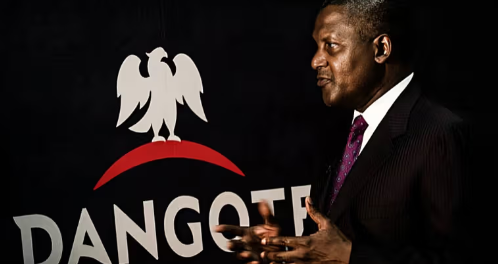
Aliko Dangote, chairman of the refinery and president of Dangote Industries, described the placement as a step towards broadening and further institutionalising the company’s investor base.
He said the capital would complement the refinery’s internal cash flows and external debt as it pursues its expansion programme.
The private placement is separate from the refinery’s recent debt transactions.
In March, Afreximbank said it had underwritten $2.5 billion of a $4 billion syndicated term loan for the refinery. That five-year facility was intended to refinance existing debt and adjust the company’s financing structure to its operational requirements.
Source: Africabusinessinsider