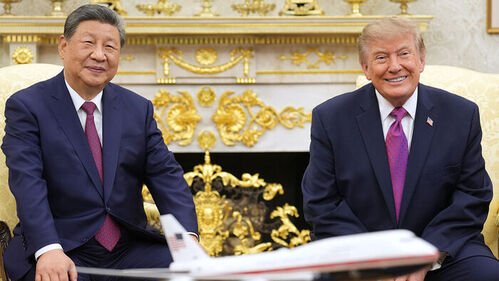
Following up on their summit agreement, the United States and China have unveiled a list of non-sensitive goods for mutual tariff reductions totaling USD 60 billion, with USD 30 billion from each side.
China has included US agricultural products and coal in its tariff cut targets, while the US has added Chinese toys and home appliances to its list.
Soybeans, which US President Donald Trump has been aggressively pushing to export to court the agricultural sector’s votes, were omitted from the list.
China’s Ministry of Commerce announced on its website on September 28 that the US and China agreed on the “USD 30 billion for USD 30 billion” mutual tariff reduction product lists during the 8th economic and trade negotiations held in New York and Washington, D.C., from September 20 to 23, disclosing the specific target items.
The Office of the United States Trade Representative (USTR) also released its corresponding list of items around the same time.
China’s tariff reduction targets include US agricultural products, personal care items, medical devices, and coal.
The US side decided to lower tariffs on approximately USD 30 billion worth of Chinese goods, including toys, home appliances, baby products, kitchen and bathroom supplies, and holiday gift items.
Notably, more than 90% of the products included in the tariff cuts will see all additional tariffs mutually imposed by the US and China removed, applying only most-favored-nation (MFN) tariff rates.
Both countries plan to implement the tariff cuts simultaneously after completing domestic legal procedures.
China’s tariff reduction list is seen as keeping in mind the implementation of its purchase commitments for US agricultural products.
During President Trump’s visit to China in May, China agreed to purchase USD 17 billion worth of non-soybean US agricultural products annually within the Trump administration’s term.
With soybeans left off China’s tariff reduction list, a 10% tariff will continue to be applied to them.
During the US-China summit in October 2025, China agreed to purchase 25 million tons of US soybeans annually, and currently, state-owned Chinese enterprises are purchasing US soybeans despite the tariffs.
The mass export of US soybeans is a crucial issue for President Trump to appease the rural sentiment ahead of the midterm elections, raising possibilities that China may have used soybeans as a leverage tool by excluding them from the tariff reduction items.
Feng Chucheng of the Hong Kong-based Hutong Research Institute told Reuters that China’s purchase of US soybeans carries profound political significance, analyzing that keeping soybean-related discussions on a separate track gives China negotiating leverage against the US ahead of the US midterm elections.
The Chinese Ministry of Commerce stated that US coal has also been included in the mutual tariff reduction targets.
The White House previously announced that China would import 10 million tons of US coal each in 2027 and 2028, though it was omitted from the Chinese side’s announcement.
The Chinese Ministry of Commerce emphasized that this tariff reduction measure will help expand China’s imports of US coal in 2027 and 2028, noting that US coal imports will complement China’s domestic coal market while providing stable revenue and jobs for the US coal industry.
In the agricultural sector, following the two sides’ in-principle agreement in May to include certain agricultural products in tariff cuts, specific consultative bodies will be launched.
The two countries will establish an agricultural working group co-led by China’s Ministry of Commerce and the US Trade Representative (USTR) under the US-China Trade Council, with its first meeting scheduled to be held before the end of this year.
The Chinese Ministry of Commerce stated that through the working group meetings, it will continue to urge the US side to resolve China’s concerns in the agricultural sector.
Bloomberg noted that while the tariff cuts on USD 60 billion worth of goods are among the notable outcomes of Chinese President Xi Jinping’s visit to the US, they account for only a fraction of the USD 415 billion total bilateral trade between the US and China.
An in-principle agreement was also reached in the financial services sector.
China decided to review and decide on approval applications for business operations and branch establishments in China by foreign financial service institutions, including US financial institutions, in accordance with relevant laws and regulations.
Source: SBSNews