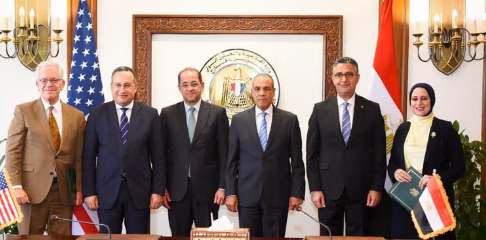
The agreement could eventually mobilise as much as $625 million in US contributions, according to Egyptian Deputy Foreign Minister for International Cooperation Samar Al-Ahdal.
It targets some of Egypt’s most economically important sectors, including energy, water management, infrastructure, artificial intelligence, agriculture, food security, healthcare, education and workforce development.
The agreement could give American companies and technology providers greater access to one of Africa’s largest economies while supporting Egypt’s attempts to modernise public services, create jobs and attract private investment.
Reuters reported on November 5 that the United States had committed $125 million to the agreement. However, subsequent comments from Egyptian officials showed that the amount is the first round of a broader framework that could reach $625 million over five years.
First agreement of its kind between Washington and Cairo
The Strategic Objective Agreement for Advancing Mutual Prosperity is the first bilateral arrangement of its kind between Egypt and the United States.
It was signed on November 4 by US Embassy Chargé d’Affaires Robert Silverman and Egypt’s Deputy Foreign Minister Samar Al-Ahdal.
Egyptian Foreign Minister Badr Abdelatty attended the ceremony alongside ministers responsible for finance, supply and internal trade, and higher education and scientific research.
The Egyptian government said the framework would bring American institutional expertise and technology into the development of the country’s water, energy and infrastructure systems.
It will also support the modernisation of education, healthcare and government services, while promoting food security through science-based agriculture.
For Washington, the agreement is also explicitly commercial. The US Embassy said it was intended to expand opportunities for American businesses and support private-sector growth in both countries.
Silverman said the two countries would use Egypt’s geographical position, workforce and growing market to advance economic modernisation and create new opportunities for US companies.
The difference between $125 million and $625 million
The two figures connected to the agreement should not be treated as interchangeable
The United States has committed $125 million under the first annual agreement. Al-Ahdal said the broader American contribution could reach $625 million over five years, equivalent to five annual commitments of $125 million.
The government has not published a breakdown showing how much will go to energy, artificial intelligence, water, healthcare or the other sectors included in the framework.
No American companies, Egyptian businesses or individual projects have been named as recipients.
It would therefore be inaccurate to report that $625 million has already been invested in Egypt or allocated among the sectors. The confirmed commitment at this stage is $125 million.
American companies gain access to a growing trade relationship
The agreement comes as trade between the United States and Egypt continues to expand.
Bilateral trade in goods and services reached an estimated $16.1 billion in 2025, an increase of 28.9% from the previous year.
US exports of goods to Egypt rose 47% to $9.4 billion, while Egyptian goods exports to the United States increased 12% to $2.8 billion.
That left the United States with a goods-trade surplus of approximately $6.6 billion, up 70.1% from 2024.
Trade in services reached an estimated $3.8 billion. US services exports to Egypt stood at $2.2 billion, compared with $1.6 billion in services imported from Egypt.
The latest framework builds on the US–Egypt Trade and Investment Framework Agreement, which has provided a platform for bilateral trade and investment discussions since 1999.
The new arrangement, however, moves beyond regular policy discussions by attaching a confirmed funding commitment and identifying sectors in which American technology, companies and expertise will be deployed.
Its eventual economic impact will depend on which projects receive funding, how much of the five-year ceiling Washington ultimately commits and whether the agreement generates additional private investment beyond the government-backed programme.
Source: Africabusinessinsider