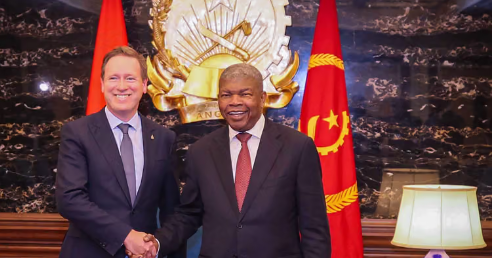
Chief executive Al Cook said a successful exploration programme could eventually lead to a diamond mine requiring billions of dollars in investment.
However, the proposed mine remains conditional. De Beers has not announced a commercially viable discovery, approved a mine or provided a formal development budget.
According to the Angolan presidency’s official communications platform, Cook disclosed the $15 million exploration expenditure after meeting President João Lourenço at the Presidential Palace in Luanda.
“We will try to develop the exploration into a diamond mine. This is a very serious investment, which could reach billions of dollars,” Cook said.
Cook made clear that the potential investment would depend on the results of the current prospecting work.
De Beers is also investing more than $15 million in sustainable environmental projects in southern Angola. That expenditure is separate from the $15 million spent on diamond exploration and should not be added to the exploration figure.
De Beers expands its search to 16 areas
Angola’s Ministry of Mineral Resources, Petroleum and Gas separately confirmed that De Beers had expanded its exploration operations to 16 areas.
The disclosure followed Cook’s meeting with Mineral Resources, Petroleum and Gas Minister Diamantino Azevedo on November 3.
The company wants to move from early prospecting to production projects if drilling and geological studies identify diamonds that can be extracted profitably.
De Beers returned to Angola in 2022 after leaving the country in 2012. It signed two mineral-investment contracts with the government covering exploration and potential mining activities.
The agreements created joint ventures with Endiama, Angola’s state-owned diamond company, and gave De Beers access to exploration areas in the country’s north-east.
In February 2024, De Beers signed a wider memorandum of understanding with the Angolan government, Endiama and state diamond-marketing company Sodiam.
The partnership covers exploration, the evaluation of existing deposits, diamond traceability, support for artisanal miners and the international promotion of Angolan stones.
De Beers says its Angola operation has also assembled and trained a workforce that is 90% Angolan.
First new De Beers kimberlite field in more than 30 years
The company’s renewed Angola strategy produced an important geological breakthrough in 2025.
In July of that year, De Beers and Endiama encountered kimberlite while drilling one of their priority targets. Kimberlite is the rock formation in which diamonds can occur.
De Beers described it as its first discovery of a new kimberlite field in more than three decades. The announcement did not establish that the deposit contained diamonds in sufficient quantities or quality to support a commercial mine.
Further drilling, laboratory analysis and geological work are required before the company can estimate the size, grade and economic value of any deposit.
This distinction is important because discovering kimberlite does not automatically mean that a profitable diamond mine will follow.
De Beers’ $15 million represents money already spent on exploration. Cook’s reference to billions of dollars describes the possible cost of developing a future mine if commercially viable diamonds are confirmed. No final investment decision has been taken.
Angola rises among the world’s largest diamond producers
De Beers’ expanding search comes as Angola strengthens its position in the global natural-diamond industry. Angola produced approximately 15.2 million carats of rough diamonds in 2025, according to Kimberley Process data. The stones were valued at about $1.81 billion.
The country exported 17.06 million carats worth approximately $1.65 billion during the year. Exports can exceed annual production when they include diamonds held in inventories from previous periods.
The Angolan mining ministry, drawing on the Kimberley Process figures, ranked the country as the world’s third-largest rough-diamond producer by volume in 2025, behind Russia and Botswana. Despite its production, De Beers believes large parts of Angola remain insufficiently explored.
A major investment during uncertainty over De Beers’ ownership
The Angola expansion is proceeding while De Beers’ own ownership remains under review. London-listed Anglo American owns 85% of the diamond company, while the government of Botswana holds the remaining 15%.
Anglo American has been seeking to sell its stake as part of a wider restructuring, following weak natural-diamond prices, reduced luxury demand in China and increasing competition from laboratory-grown stones.
Angola has previously expressed interest in obtaining a stake in De Beers as African diamond-producing countries seek greater influence over the production and marketing of their natural resources.
For Angola, the immediate issue is whether the 16 exploration areas produce a commercially viable discovery. If they do, the country could host a new mine requiring considerably more capital than the $15 million invested in prospecting so far.
Source: Africabusinessinsider