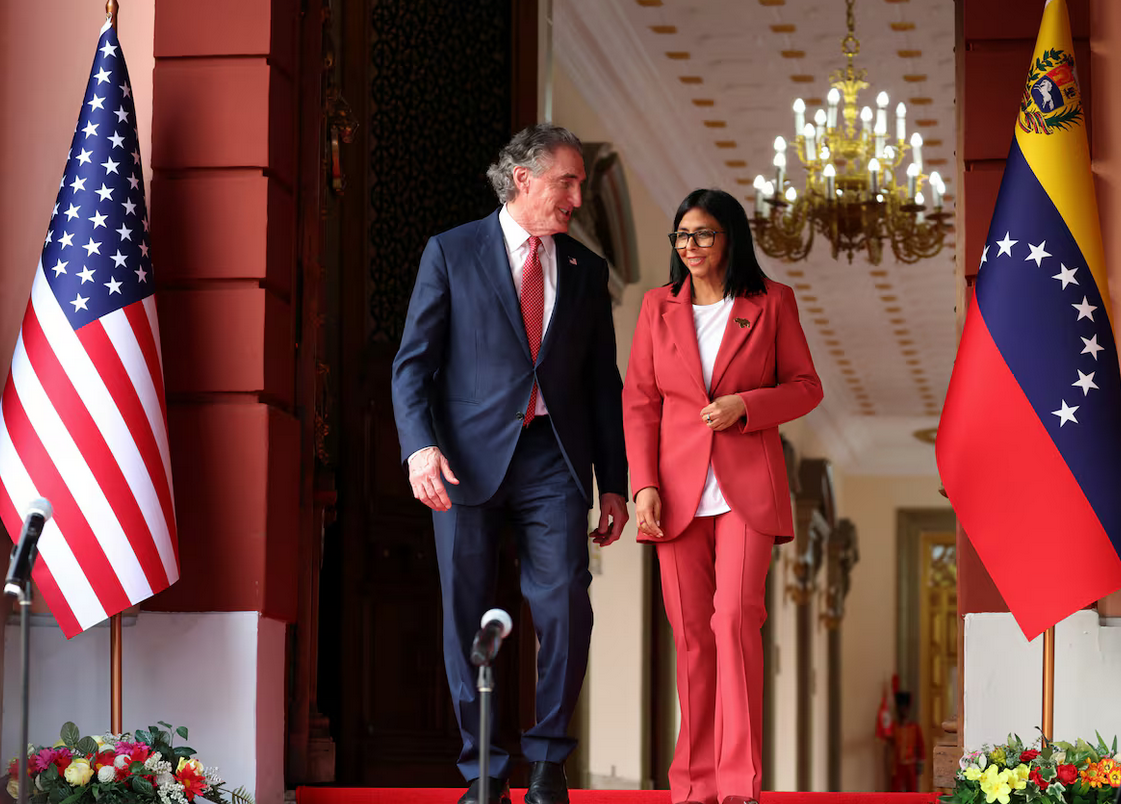
Since January 3, Venezuela has opened its natural resources to the United States. First it was oil. Crude extracted from Venezuelan wells has returned to what was for years its main customer, and Washington has reciprocated by granting the necessary licenses. Then, the Venezuelan parliament, led by Jorge Rodríguez, the brother of acting president Delcy Rodríguez, amended the hydrocarbons law, and a few days ago, the first contract with Shell was signed. The same pattern is now being repeated for mining operations.
U.S. Interior Secretary Doug Burgum paved the way during his two-day visit last week, which also included representatives from some 20 U.S. mineral companies, many of which operated in Venezuela in the past but ended up leaving due to expropriations during Hugo Chávez’s tenure.
Upon his return to Washington, a license was issued authorizing transactions with the Venezuelan state-owned gold mining company Minerven. According to the license, as was also the case with oil, individuals and companies from Russia, Iran, North Korea, and Cuba are not authorized to enter into contracts with Minerven. The following day, the first shipment of gold, valued at $100 million, arrived in the United States. According to Burgum, it will be used for both industrial and commercial purposes.
“Venezuela has got $500 billion of resources of gold, but they’ve also got other critical minerals. Bauxite for aluminum, which we need for defense and for consumer goods,” the official said in an interview with a U.S. media outlet upon his return. “They also have coal resources that can be used to generate energy.”
The Venezuelan Parliament is currently debating a new mining law that was placed on the agenda this Tuesday. The legislation seeks to “establish new rules for the management of the country’s mineral resources.” During the presentation, lawmakers indicated that the law addresses legal security, foreign investment, and the incorporation of new contracting mechanisms for the administration of mineral resources. These are the same aspects that were central to the reform of the hydrocarbons law, but further debate is needed before its approval.
Burgum has asserted that the Venezuelan government provided security guarantees to mining companies interested in investing in the country. The reference to security was reiterated several times in the official’s statements while in Venezuela. However, the mineral-rich areas in the south of the country have long been controlled by guerrillas, criminal gangs, and other illegal groups.
When Donald Trump initiated the siege against Nicolás Maduro last year, he made clear his interest in the South American country’s resources. The deployment of military vessels in the Caribbean was accompanied by statements in which the president asserted that Venezuela had stolen oil from the United States. The military intervention and the capture of Nicolás Maduro and his wife, Cilia Flores, ultimately precipitated these plans.
In addition to possessing the world’s largest oil reserves, the Caribbean nation boasts enormous gas fields—the sixth largest globally; vast gold reserves, the most significant in Latin America; iron ore, ranking 12th in the world; bauxite, ranking 15th; and diamonds. Before the collapse of the Chavista regime, the country had made significant progress in the exploitation and export of several of these commodities, particularly oil, gas, iron ore, and processed aluminum and steel products, cornerstones of contemporary Venezuela.
Source: englishelpais