U.S. President Donald Trump’s push to secure rare earth supply deals across Asia will ultimately weaken China’s dominance in the global supply chain for critical minerals — but analysts said the buildup will take years.
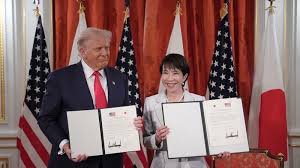
Over 10 days, Trump cemented deals with Australia, Malaysia, Cambodia and most recently, Japan, to bolster the supply of rare earths and other critical minerals that are crucial for the making of batteries, automobiles, defense systems and computing chips.
The flurry of deals — part of Washington’s bid to counter Beijing’s chokehold on the sector — comes ahead of his meeting with Chinese President Xi Jinping in Busan on Thursday.
The deals may “benefit immensely from being linked together in a plurilateral agreement with strong commitments, financing and pooling of resources,” said Wendy Cutler, senior vice president at Asia Society Policy Institute. She expects more of such deals to follow under the Trump administration.
Trump and Xi are expected to address several contentious issues that have stalled the long-running trade talks, including Beijing’s rare earth export controls and Washington’s tariff threats and technology restrictions.
The most recent win for Trump was an agreement with Japan aimed at securing the supply of raw and processed critical minerals while also pledging funding for selected projects within the next six months. Earlier pacts with Australia, Malaysia and Thailand also outlined multibillion-dollar plans, commitments to fair trade practices and to avoid export bans or quotas.
While Trump’s deals will bring much-needed financial support to the industry and may eventually challenge Beijing’s stranglehold over rare earths, experts said the efforts will be costly and take years to bear fruit.
“What we are trying to do now is to get off the Chinese as the primary supply chain, but that will take time,” said Dennis Wilder, a former senior U.S. intelligence official and now a senior fellow at Georgetown University.
“In the medium term, we will get off the Chinese supply chain, but in the short term, there’s still a great deal of dependency on China,” Wilder stressed.
Goldman Sachs estimates new rare earth mines tend to take up to a decade to develop, with known reserves for certain elements “very scarce” outside of Myanmar and China, while building refineries would take about 5 years.
China dominates 69% of the market share for rare earth mining, 92% of refining and 98% of magnet manufacturing, the bank estimates.
Source: cnbc