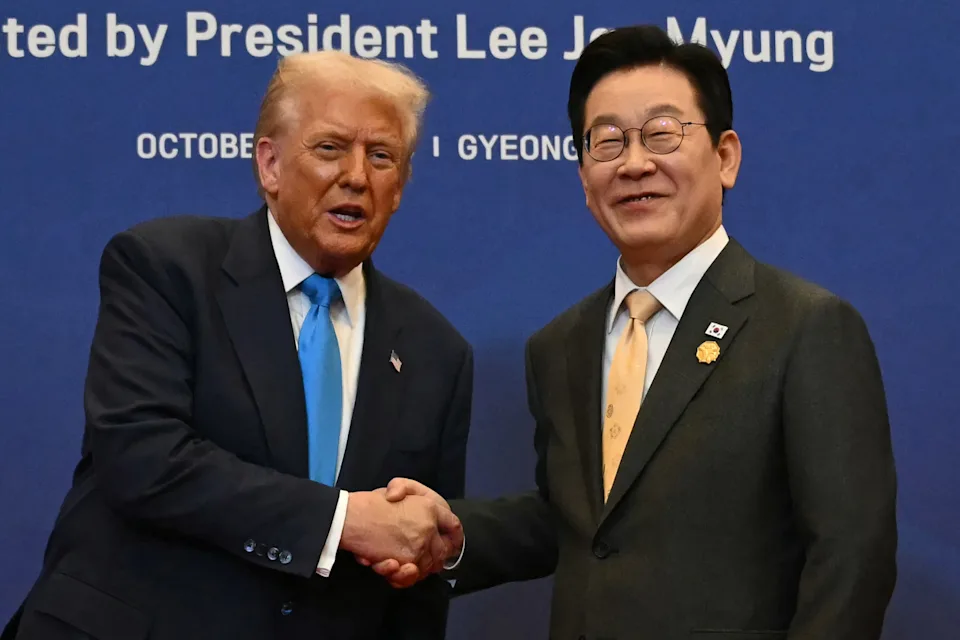
US President Donald Trump and South Korean President Lee Jae Myung finalized a trade deal Wednesday, capping months of negotiation over implementation of a framework agreement struck in July.
The deal will see Seoul make $150 billion in shipbuilding investments, with an additional $200 billion earmarked for an investment pledge designed to look like a similar agreement with Japan, South Korea Policy Chief Kim Yong-beom said Wednesday. That suggests South Korea can use not only equity but loans and loan guarantees to fund the investment package, a key concession.
Trump called his meetings with South Korea “tremendous” and said they had “pretty much finalized a trade deal” during a dinner hosted by Lee in his honor on Wednesday night.
“I think we came to a conclusion on a lot of very important items,” Trump said.
The won gained as much as 0.9% against the dollar following the first report of the deal. South Korea’s finance minister said last week that recent weakness in the won reflected concern that the deal hadn’t been finalized.
Trump in a social media post hailed the investments from South Korea and the lowered tariff rate for the country, while providing few additional details beyond those offered by Seoul.
Trump said South Korea had “agreed to buy our Oil and Gas in vast quantities,” and that investments made by the country’s businesses in the US would top $600 billion.
Ahead of the breakthrough, South Korea and the US had played down the notion that the two sides could finalize the agreement, which will see the US cap tariffs on South Korean goods at 15%, during Trump’s visit.
US duties on Korean car imports had remained at 25% while the talks continued. That left the nation’s automakers at a competitive disadvantage against their Japanese rivals since Tokyo finalized its deal in September. Those duties will now come down to 15%, according to Kim.
Just days before the deal was sealed, Lee said key details of a $350 billion investment package remained sticking points, while Trump called the agreement “pretty close” to completion, highlighting a gap in perceptions even as talks neared the finish line.
Source: Financeyahoo