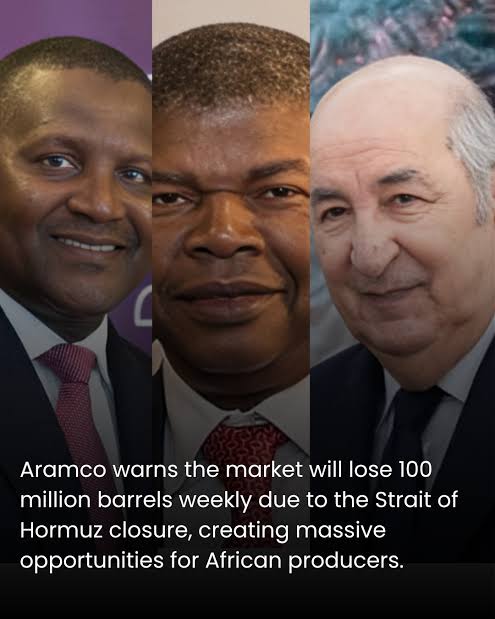
The African oil industry, which has benefited from price increases following Russia’s invasion of Ukraine, is now confronted with fresh challenges and opportunities as the disruption of the Strait of Hormuz continues, prompting efforts to address supply gaps ahead of a market reset.
Saudi Aramco’s CEO, Amin Nasser, warned that “the oil market will lose 100 million barrels of supply every week the strait remains closed,” as only a fraction of the usual vessels are able to pass through daily.
According to the him, the market has already lost more than 1 billion barrels due to the closure, with around 880 million barrels redirected through Aramco’s east-west pipeline and strategic reserves released by governments.
Nonetheless, with global oil inventories depleting rapidly, African oil producers like Nigeria, Angola, and Algeria are stepping in, ready to capitalize on opportunities as the market shifts.
Angola’s Oil Sector
Angola’s oil industry remains resilient despite ongoing challenges. According to an Oil and Gas Report, the nation exported 86.18 million barrels of crude oil, valued at $7.16 billion in Q1 2026.
While this represents a 9.14% decrease in volume from the previous quarter, higher international prices drove an increase in export value, with Brent crude averaging $81.13 per barrel.
In March 2026, the country saw a slight increase in exports, reaching 1,152,930 barrels per day (BOPD), surpassing its production of 1,021,633 BOPD. This reflects Angola’s positive strides in increasing its export capacity.
Volza’s trade intelligence data reveals the country sent crude oil to 28 buyers globally between July 2024 and June 2025, with major importers including the U.S., Singapore, and China.
Key exporters were PETCO TRADING UK LIMITED (41% market share) and CHEVRON USA INC (17% market share), while India’s Indian Oil Corporation (IOC) accounted for 41% of global imports.
Notably, India’s largest refiner, Indian Oil Corporation (IOC), recently purchased 2 million barrels of crude for March delivery.
The nation’s refining capacity is expanding to meet growing domestic and international demand.
The Luanda refinery, with a current capacity of 65,000 BPSD, is undergoing an expansion to increase output fourfold to 1.58 million litres per day, reducing reliance on imported refined products by up to 15% annually.
The newly completed 30,000 BPSD Cabinda Refinery will begin operations by Q2 2026, enhancing refining capabilities. Additionally, the Lobito Refinery, with a planned capacity of 200,000 bpd, will further strengthen Angola’s refining sector once completed.
At the Angola Oil & Gas (AOG) 2026 conference, the nation plans to attract $70 billion in investment and increase local content participation in the oil sector to 20% by 2027.
Nigeria’s Oil Transformation
Nigeria’s oil sector is undergoing significant transformation, largely driven by the growing capacity of the Dangote Refinery.
The refinery, with a current capacity of 650,000 barrels per day (bpd), has helped Nigeria shift from being a net importer of petroleum products to a net exporter.
By March 2026, Nigeria had officially become a net exporter of petrol, with the Dangote Refinery producing 57 million litres of petrol daily.
The refinery supplies 95% of the Jet A1 fuel consumed nationwide and, between March and April 2026, exported approximately 876,000 metric tonnes (over 1.1 billion litres) of aviation fuel to Europe.
Additionally, the refinery began exporting petroleum products, shipping 456,000 tonnes (12 cargoes) to African countries, including Togo, Niger, and Ghana, as well as to the UK.
Volza’s data reveals that Nigeria’s crude oil exports, particularly under HSN Code 2709, amounted to 1,275 shipments between June 2024 and May 2025, facilitated by 13 exporters.
Top buyers included Singapore, China, and Turkey, while the European Union remained a key market for Nigerian crude.
Among the top-performing crude oil exporters were Shell International Trading Midd (20% market share) and ADDAX ENERGY SA (18% market share).
According to the United Nations COMTRADE database, the European Union imported $14.23 billion worth of crude oil from Nigeria in 2025.
Despite a 15.06% decline in U.S. crude oil imports from Nigeria in Q1 2026, Nigeria’s refining sector continues to grow, particularly through the expanding capacity of the Dangote Refinery.
Source: Africabusinessinsider