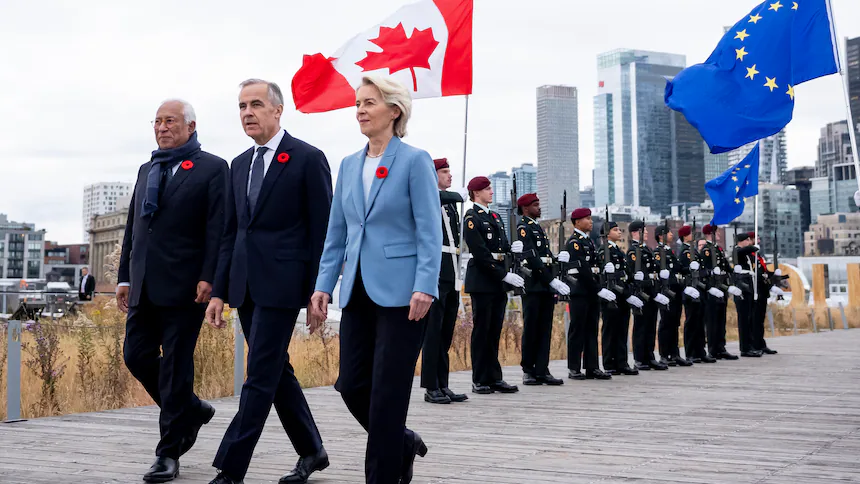
Prime Minister Mark Carney said Canada is working to become the European Union’s first associate member, his most definitive statement on the issue to date after hosting the bloc’s leaders in Montreal this week.
It still remains unclear what that would look like and cost.
This year’s Canada-EU summit saw Canada and European officials finalize a number of negotiations and launch a long list of new commitments as part of a deeper alliance, but the issue of what to call the allies’ deeper partnership has somewhat overshadowed the work between Ottawa and the 27-member bloc given some members are against the proposal.
“We are working toward the deepest possible partnership, short of accession because of our geography, with Canada becoming the European Union’s first associate member,” said Carney in his closing remarks.
“Over the coming months, we will determine the substance, scale and scope of this form of membership.”
Carney previously stayed away from using the “associate member” title, instead arguing the nomenclature doesn’t matter.
By Friday, though, he added a timeline to the debate, saying the plan is to conclude negotiations in June, when he’ll join European Council meetings.
He also said he, European Commission President Ursula von der Leyen and European Council President António Costa will convene the College of the European Commissioners and Canada’s federal cabinet in March.
Von der Leyen first raised the prospect of making Canada an associate member — a status that doesn’t currently exist in the bloc — in a speech last month and has continued to spearhead the initiative despite objections from some members, notably Germany.
No talk of cost
Speaking on background after the news conference, a Canadian official couldn’t answer what legislation would be needed in Canada and across the EU member states.
“It’s a concept,” the official said, noting there’s no existing formal process to becoming an associate member.
Asked what the cost of joining as an associate member could be, Carney said “we don’t view this as paying for something, we view this as coming together.”
While von der Leyen, Costa and Carney are all now championing the title, it’s far from a done deal. EU members would have to vote, and Carney has said a new partnership with the European Union will be put up for debate and a vote in Canada’s Parliament.
“Canada is by far the most European of the non-European countries,” Costa said on Friday morning.
Canada-EU sign agreements
Division over what to call the partnership was apparent in the crafting of the joint statement released at the end of the summit.
Sources with knowledge of what happened said the “associate member” term was removed from the draft version, given some members’ disapproval.
Source: cbc