For decades, Germany seemed immune to the China shock that has wreaked havoc on Western manufacturers.
After Beijing joined the World Trade Organisation (WTO) in 2001 and flooded markets with cheap goods, Germany’s carmakers and chemicals producers not only stood strong but benefited from selling to the new Chinese market.
However, German policymakers and industrialists became complacent as China pursued closer business ties. Cue what economists have coined the “China Shock 2.0” and Germany is suddenly one of the most vulnerable countries in the world.
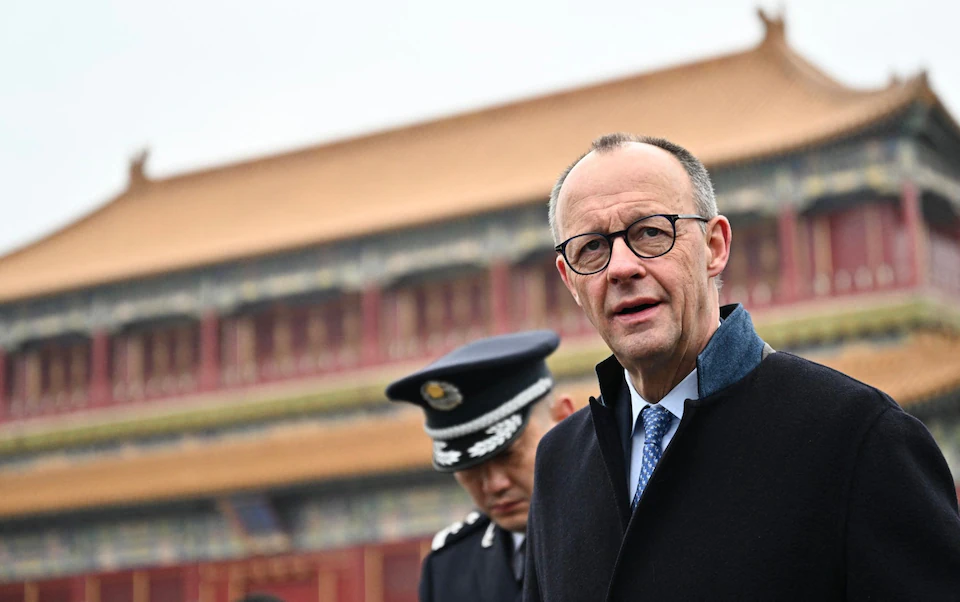
Now, German-China relations are undergoing a sea change as Chancellor Friedrich Merz wakes up to how Beijing’s new era of global dominance is hammering the German economy.
As recently as 2020, Germany had a trade surplus of nearly €20bn (£17bn) with China. This is now a deficit of €21bn.
Analysis by the Global Public Policy Institute shows that while many countries, including the UK, have reduced their exposure to China in recent years, Germany has become increasingly vulnerable. Since 2013, Germany has moved from the 10th most exposed country to China to the third, behind only South Korea and Russia.
In a Centre for European Reform paper earlier this year, economists Sander Tordoir and Brad Setser warned that “China Shock 2.0” is similar in scale to the first one, which followed China’s accession to the WTO in 2001. Back then, China’s manufacturing surplus climbed to nearly 1pc of global GDP. In the last four years, this has grown by almost another percentage point.
But this time the shock is more existential. In the 2000s, when the West lost manufacturers who made toys, furniture and basic electronics, they did not lose sectors that were central to the future dynamism of their economies, Tordoir and Setser argued.
Countries such as Germany also gained major new export markets in chemicals and machinery. This time, China is not increasing its imports. And the sectors that it is now competing with – namely cars, machinery and chemicals – are vitally important to Germany’s economy.
Chinese goods are now not only cheap but high quality and Germany is suddenly seeing its core exports squeezed out of China and other foreign markets, but also at home.
“For years, the German elites told themselves that interdependence meant mutual dependence, but the latest numbers look less comfortable,” says Sari Arho Havrén, a China foreign-relations specialist at the Royal United Services Institute (Rusi).
Cars, an industry which Germany has dominated for decades, are at the heart of this second wave of Chinese exports.
Analysts had expected that China would export 10 million cars a year by the end of the decade. But on an annualised basis, China’s car exports hit this threshold in the last three months of 2025.
“In the automobile sector, the tipping point was really when Chinese companies started leading the field in electric vehicles and hybrid cars,” says Jessie Yin, associate director at the Atlantic Council’s Geoeconomics Centre.
This is one reason why China’s export volumes last year grew at more than double the pace of global trade.
As China’s star ascends, Germany is left flailing. Its exports have been falling steadily since 2018 and dropped by around 5pc last year. The industries most exposed to Chinese competition have been shrinking most markedly. Its industrial production has been falling for six years and economic output is still around 6pc below its pre-pandemic trajectory.
Tordoir and Setser, of the Centre for European Reform, warn: “China shock is now the most important cause of Germany’s malaise.”
It has much further to fall. A report published earlier this year by the French prime minister’s planning office warned Chinese competition could threaten 70pc of Germany’s manufacturing output over the medium term.
Source: telegraph