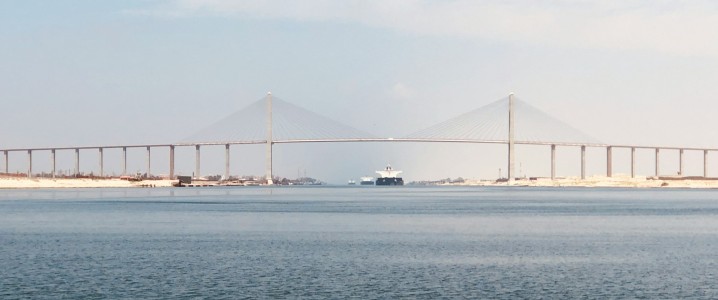
The Houthi threats to shipping in the Red Sea and its chokepoint, the Bab el-Mandeb Strait, have forced at least one oil tanker carrying Saudi crude to Asia to choose the much longer route through the Suez Canal, the Mediterranean, and around Africa.
The supertanker Olympic Luck, partially laden with Saudi crude at Yanbu on the Red Sea, transited the Suez Canal into the Mediterranean late on Sunday, according to shipping data monitored.
The U-turn from Bab el-Mandeb indicates that some tanker owners aren’t willing to risk crossing southward into the Arabian Sea on the much shorter route to Asia, as the Iran-aligned Houthis have threatened – and struck – Saudi tankers in the Red Sea in recent days.
The Greece-flagged Greece-owned Olympic Luck is signaling an unspecified location in Asia.
Other tankers continue to transit the Bab el-Mandeb Strait, but in numbers that are the lowest in months, various ship-tracking services showed this weekend.
Traffic through Bab el-Mandeb has materially slowed, and some vessel owners have their tankers move northward in the Red Sea toward the Suez Canal. The Suez-Africa route to Asia makes the journey about a month longer than if tankers travel through Bab el-Mandeb.
Last week, a Denmark-flagged oil and chemical products tanker, the Torm Innovation, turned away from Bab el-Mandeb and moved north toward the Suez Canal. The tanker, which had loaded products at Yanbu, was in the East Mediterranean early on Monday, shipping data on MarineTraffic showed.
Despite the reduced traffic through Bab el-Mandeb, “Saudi crude has not stopped moving. It has bifurcated,” maritime intelligence firm Windward said on Sunday.
“Yanbu port has transitioned to entirely AIS-dark tanker operations at berth as vessels shield against a Houthi hit list,” it added.
Saudi Arabia has established a working alternative export route via the SUMED pipeline in Egypt and around the Cape of Good Hope in Africa, adding cost and voyage time but demonstrating the market’s adaptability, Windward noted.
Source: Oilprice