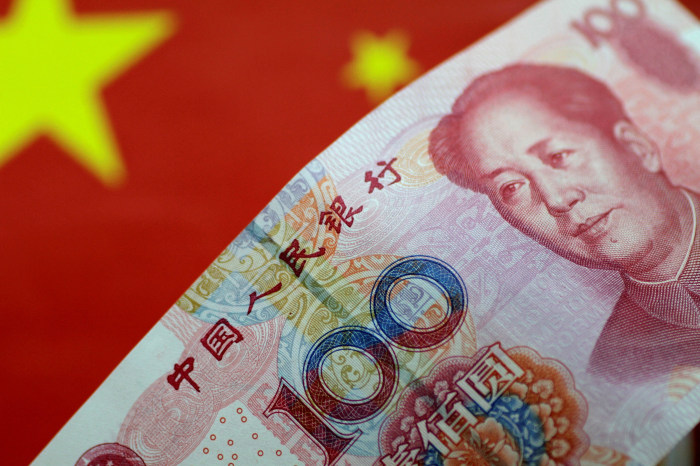
Xi Jinping doesn’t like a weak yuan. A soft renminbi feels, at least to the Chinese leader, like a loss of face—a sign of weakness he’d rather not project to the world. And yet, by the reckoning of one of the most respected currency hands in Washington, China’s currency is between 20% and 30% below its true value.
That’s the paradox at the center of this week’s column, and I owe it to a conversation with Mark Sobel, a former senior U.S. Treasury official who spent decades on international monetary policy and later represented the U.S. at the International Monetary Fund. Sobel, now chief economist at the independent Official Monetary and Financial Institutions Forum, walked me through why the yuan’s cheapness is baked into the structure of the Chinese economy.
Economists have a saying: A country’s current account balance is just the difference between how much it saves and how much it invests. China saves an enormous amount—partly because its financial system is built that way, and partly because households, facing a threadbare social safety net, sock away cash for old age and for illness. The so-called iron rice bowl isn’t what it used to be, as Sobel put it.
All that saved money gets funneled by state-owned banks into state-owned enterprises and favored industries—artificial intelligence, semiconductors, electric cars—to keep production humming, whether or not anyone at home is actually buying what’s being made. Some of that output is genuinely impressive. But much of it is what Chinese officials now call “involution”: companies and local governments locked in a race to keep factories running long after it stops making economic sense, just to hit growth targets or preserve jobs.
Either way, production collides with weak domestic demand—held back by low confidence, near-zero inflation and the housing bust. The surplus has to go somewhere: exports.
By Sobel’s calculations, China’s manufacturing export surplus alone now tops 10% of GDP, feeding the trade tensions many economists call “China shock 2.0.”
Run current-account numbers through the IMF’s exchange-rate framework, Sobel said, and you land on a striking conclusion: the yuan is 20% to 30% undervalued.
Yes, the yuan has firmed this year. But Sobel’s second point punctures some of the excitement. Look at the real, inflation-adjusted exchange rate, and the currency is still down roughly 15% since 2022. Here’s the trick that’s easy to miss: If U.S. inflation runs at 3% and China’s is near zero, then even a currency pair that doesn’t move at all is quietly handing China a roughly 3% competitiveness gain every year. Standing still, when your inflation is near zero, is itself a form of getting cheaper.
So what drove the yuan higher this year? A mix, said Sobel: the current account surplus, a weaker dollar as Trump talked it down, and a slow climb as exporters, sensing Beijing was comfortable with the rise, brought their dollar earnings home instead of parking them offshore. (That herd behavior cuts both ways: exporters hoard dollars when the yuan falls, and pile back in when it rises.)
There’s also a lively debate over how much Chinese state banks are managing the pace behind the scenes. Nobody, Sobel concedes, knows how large that effect is.
The Xi factor
Here’s where my own reporting adds a wrinkle to Sobel’s economics. Xi’s aversion to a weak yuan isn’t about rebalancing toward consumption—it’s about face and geopolitics.
I remember early last year, right after Trump returned to the White House threatening fresh tariffs, when China’s central bank found itself in a genuine bind. Officials knew a weaker yuan would cushion exporters against tariffs, just as it had in the first U.S.-China trade war, but they also knew their boss doesn’t like a soft currency. Managing that contradiction was, by multiple accounts, exhausting inside the People’s Bank of China.
Then came Trump’s serial walk-backs—the “TACO” pattern, as traders call it—tensions eased, and the yuan stabilized and firmed. People inside the PBOC, I’m told, breathed a sigh of relief.
Now, where does the yuan go? Sobel doesn’t expect a dramatic revaluation—just what Beijing has delivered so far: slow, cautious appreciation calibrated to preserve stability above all. Because the currency starts so undervalued, Beijing has considerable room to let it rise without hurting competitiveness, a useful cushion as Washington and Brussels both lose patience with Chinese exports.
What Beijing isn’t doing, Sobel argues, is showing any appetite to fix the underlying machine, namely China’s problematic growth model—the savings glut, the state-directed investment, the export dependency—that help keep the yuan cheap and consumption low in the first place. So the pattern holds for now: exports keep doing the heavy lifting, trade tensions keep simmering, and the boost to household consumption that a much stronger yuan could provide remains out of reach.
Source: msn