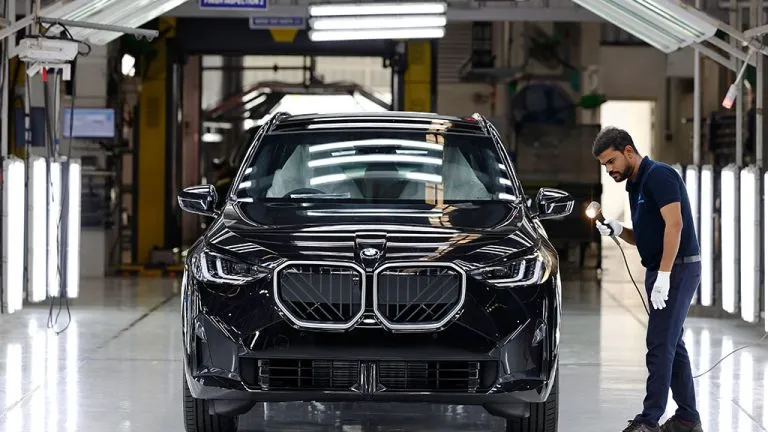
German companies, including carmaker BMW (ETR:BMW) and defence contractor Rheinmetall (ETR:RHM), have signed an agreement to establish an industry-led trading house aimed at securing supplies of critical raw materials.
The proposed trading house would pool industrial demand to purchase, store, and distribute raw materials essential to a range of components and products, from batteries and wind turbines to military radar systems.
Under the plan, the German Government would be involved through a new Agency for Raw Material and Energy Security, which would coordinate financing and facilitate cooperation between industry, the state, and international partners.
Funding would be drawn from existing sources, including Germany’s raw materials fund, while international financing mechanisms would be deployed more strategically, according to a statement cited by Bloomberg.
The initiative remains in the pre-founding stage, with the organisational, legal, and economic foundations for the trading house expected to be established by mid-2027.
Pooling industrial demand
The initiative, first reported by The Financial Times in March, is partly inspired by Japan’s efforts to diversify its critical minerals supply chains and reduce its dependence on China for rare earth elements.
Under the proposal, a group of German companies would jointly own the trading house and commit to purchasing minimum quantities of certain raw materials, helping guarantee stable demand and strengthen their collective purchasing power.
Smaller companies would also be able to participate in joint procurement without acquiring an ownership stake.
An existing commodity trading firm would be brought into the venture to provide industry expertise, operational infrastructure, and access to international markets.
During its first two years, the trading house would primarily focus on joint procurement to prevent supply shortages.
Over the longer term, it would seek to address structural supply chain dependencies by investing in new sources of supply, including mining and mineral processing projects.
Reducing dependence on China
The initiative comes as Berlin takes a tougher stance towards Chinese trade policies amid growing concerns over Europe’s dependence on a handful of countries for critical raw materials.
Speaking at the initiative’s launch in Berlin on Monday (23 November), German State Secretary Frank Wetzel warned that countries “who cannot secure their raw materials become supplicants and pawns”.
Wetzel added that nearly one in 11 jobs in Germany, Europe’s largest economy, depends on the availability of rare earth elements.
German Foreign Minister Johann Wadephul also voiced support for the initiative, warning that existing supply chain dependencies “make us vulnerable” and calling for them to be reduced as quickly as possible.
Germany’s automotive industry, a cornerstone of the country’s economy, is among the sectors particularly exposed to potential disruptions in critical minerals supplies.
“Dependence on a few supplier countries makes our supply chains vulnerable to geopolitical tensions, export restrictions and price jumps,” says Hildegard Müller, president of the German Association of the Automotive Industry, which is participating in the initiative.
Source: Mining