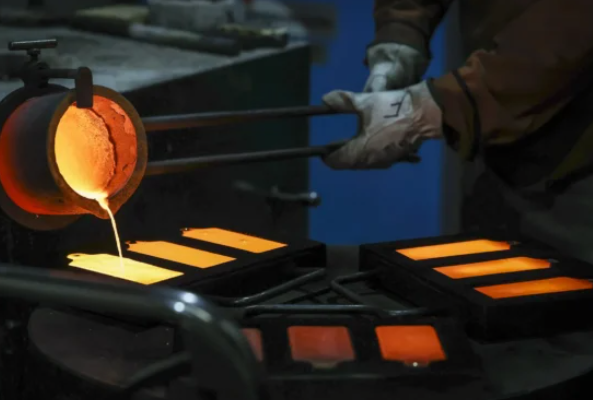
Zambia has launched a new gold refinery as the country seeks to expand domestic mineral processing, formalise gold production and retain more value from its natural resources.
Developed by Minera Refineries Zambia Limited, the facility is designed to refine gold to purity levels ranging from 99% to 99.99%, according to information released by the company.
The Zambian Observer reported that the initiative could generate more than $1.8 billion, although details on the timeframe, revenue assumptions and basis for that estimate were not provided in the available information.
The refinery’s launch comes as African governments increasingly invest in domestic precious-metals processing to strengthen control over mineral supply chains and capture a greater share of the economic benefits generated by resource extraction.
Copper continues to dominate Zambia’s exports
Despite the new investment in gold processing, Zambia’s mining economy remains heavily dependent on copper.
Copper accounted for 66% of the country’s goods exports in 2024, generating approximately $7.5 billion. Gold contributed just 2% of export earnings, equivalent to $262 million, underscoring its comparatively limited role in Zambia’s external trade.
The refinery could provide additional infrastructure for processing locally produced gold, but its contribution to export diversification will depend on the volume of gold supplied, commercial production levels and access to buyers.
Company representatives said the refinery’s technology meets international standards. They cited gold sourced from Mpika and refined approximately two months earlier as an example of production that achieved high purity levels and attracted interest from potential buyers.
Plan targets formalisation of artisanal gold mining
Andrew Mukupa Katandula, managing director of Minera Refineries Zambia Limited, outlined a proposed two-year programme to formalise artisanal gold mining, introduce targeted pre-financing for miners and improve transparency in gold production and trade.
The approach seeks to strengthen the connection between small-scale miners and formal processing and purchasing channels. A more structured supply chain could improve traceability and provide a clearer record of gold moving through the domestic market.
However, the refinery’s long-term performance will depend on securing reliable supplies of gold and establishing transparent purchasing arrangements. Effective oversight of small-scale mining and traceable sourcing will also be important in limiting informal trade and improving visibility across the supply chain.
The company has not provided enough operational detail in the available information to establish the refinery’s processing capacity, expected annual output or the timeline for reaching commercial production.
African countries expand precious-metals refining
Zambia joins a growing group of African countries investing in local gold and precious-metals refining.
Nigeria reported the opening of a high-purity gold refinery in Lagos in January 2026, while the Democratic Republic of the Congo inaugurated a refinery in Kalemie in March. Burkina Faso opened the RAFFINOR-BF refinery in Ouagadougou in September, followed by Ethiopia’s launch of a $50 million national precious-metals refinery in October.
The facilities differ in ownership, processing capacity and operational status, but share an interest in expanding domestic mineral processing rather than relying exclusively on the export of less-processed resources.
For Zambia, the new refinery represents an additional step towards diversifying its mineral industry beyond copper. Whether it translates into materially higher export earnings and government revenue will depend on sustained throughput, access to formal gold supplies and the facility’s ability to compete commercially in regional and international markets.
Source: Africaneconomyinc